


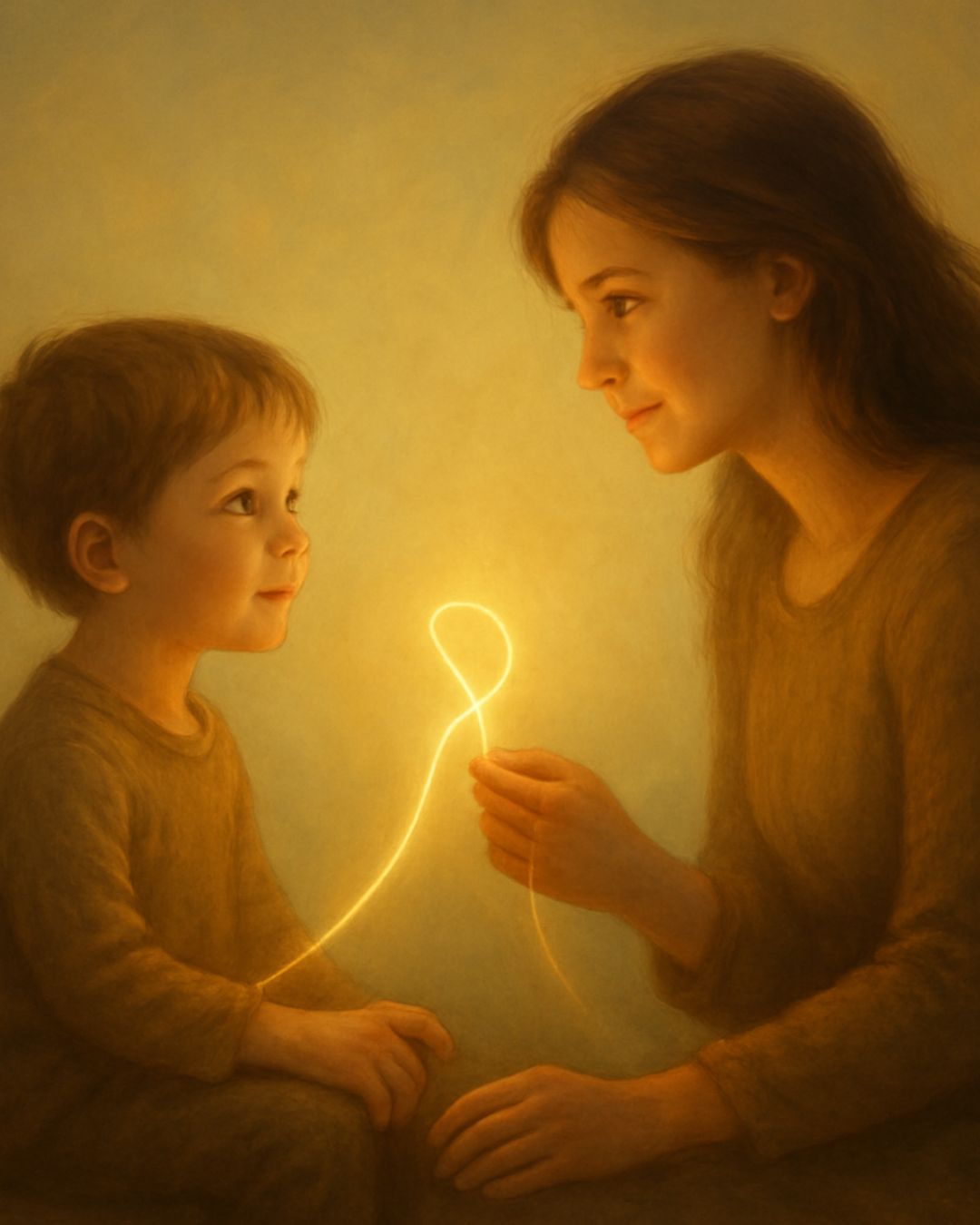
We Carry Our Family Home Into the World
We leave our family homes and step into the world, but we carry our home with us into that world. In practice, this means that what we did not receive emotionally at home follows us — often for our entire lives. Unmet childhood needs, such as the need for love, safety, recognition, to be seen and heard, show up everywhere: from trivial everyday situations, like a brief interaction with a shop assistant, to romantic, parental, and professional relationships.
In practice, it looks like this: there is a feeling of inner lack within me that I am not aware of, and it shows up in life as a constant search for people who might fill that lack. Most often, it is not really about what triggers a reaction in us in response to other people’s behavior. For example, we say, “the shop assistant is rude” — and usually, that is all we see.
What Really Happens Beneath Everyday Reactions
What actually happens is that the shop assistant’s behavior triggers certain sensations or emotions in us — something that feels uncomfortable. Some people may feel hurt, others humiliated, some become irritated, others indignant, some get angry but overwrite that anger with a mask of understanding, telling themselves that the person might be having a bad day or a difficult life.
Some of us may recognize these reactions and mechanisms, but we do not connect them with the unmet need to be recognized and seen that comes from childhood. As a result, we do not reach for freedom in our lives. While contact with a shop assistant is rare and manageable, things become more complicated in romantic relationships, where the intensity is greater and the stakes are higher.
The Dishwasher as a Symbol of Something Deeper
Here, “a picture not being hung” or “dishes not taken out of the dishwasher” become the outer layer of something deeper — such as the need for love, closeness, safety, and support. These needs are often not expressed directly, or they are expressed in a way burdened by many years of unmet longing.
The step of seeing what is really going on is more difficult, because we always prefer to hold on to something safer. It feels safer to say, “I need you to take the dishes out of the dishwasher,” than to say, “I need your support,” or even, “When you help me with household tasks, I feel loved.” These are emotionally much riskier statements.
Beyond Psychology: The Layer of Repressed Emotions
Psychology speaks a lot about this layer. However, there is another, less well-known layer that psychology often does not address. The source of these unmet needs lies in repressed emotions.
The connection works like this: when we were children, we learned that certain emotions — such as anger, hurt, sadness, or fear — were not welcomed by our caregivers. This could have been shown to us directly, for example through a parent’s emotional coldness in response to our anger, rejection, minimizing, or punishment. Alternatively, a certain attitude may have been modeled in our home from the beginning, such as submission to others, or conversely, fighting situations and people.
In the case of submission being modeled, the emotion of anger was repressed in our family home. In the case of a fight-based model, emotions such as hurt or sadness were often not expressed and were not available in the family’s emotional repertoire.
When Emotions Are Repressed, Energy Is Blocked
When an emotion is repressed — that is, when we either do not feel it at all and/or do not have access to expressing it — part of our life energy becomes blocked and inaccessible in adult life. At the same time, through modeling or being taught behavior that excluded, for example, anger, we quickly learned as children that in order to receive love, safety, recognition, and acceptance, we had to avoid that emotion.
Sometimes it was even more difficult, because we grew up in chaos, aggression, or neglect, and then cutting off those emotions ensured our survival — meaning our safety.
This mechanism of emotional repression is not visible from the outside. Since the emotion has been repressed, we do not have access to it through simple relaxation techniques, meditation, anger work, physical training, talk therapy, somatic therapy based on emotional release guided by a therapist, or anything else known to me that does not reach emotional repression through the body and process it at a deep level through awareness.
The Body Holds What the Mind Cannot Access
These repressed emotions are either not felt at all or are expressed only sporadically, for example in sudden outbursts of anger after a long period of silence and avoidance. We are not aware of this. What we are aware of are the mechanisms we have created to avoid these emotions.
Here we find a whole range of coping strategies: pleasing everyone, constant arguing, beliefs such as “I’m not good enough” or “I have to be strong,” addictions, physical ailments, and illnesses. The body holds what has been repressed. The body does not know that neck tension is often not only the result of hours spent at a computer, but also anger trapped in the body, or that smoking cigarettes is not only a diagnosis of “addiction,” but may also be a way of coping with unfelt and unexpressed hurt.
Reconnecting Body and Mind
Understanding this does not exist at the level of the conscious mind. What is repressed resides in the unconscious, and access to it is gained through the body — by creating a body–mind connection and consciously transforming this energy into freely flowing and accessible life energy.
Over time, we regain access to anger and its expression, to setting boundaries, actively asking questions, recognizing what we want and what we do not want, moving closer to people who are important to us, expressing vulnerability, our truth, and what we need.
Gradually, the fear-based mechanism of emotional repression begins to dissolve, and we regain more freedom in the body, less tension, and the obsessive need to receive love and safety from the outside begins to weaken. Natural relational needs still exist, but the unmet childhood needs that unconsciously controlled us diminish, and we find love and safety within ourselves.
Authenticity and True Closeness
At that point, we become authentic with ourselves and our environment. Sometimes only then are we able to truly — not from learned behavioral tactics — move closer to another human being.
The method that offers the possibility and precise tools for working with emotional repression through the body and awareness is the Kiloby Inquiries method. It operates on a mentoring basis, during which a person learns to use the tools, receives guidance from a mentor who has gone through their own process and understands the intricacies of our defense mechanisms, applies the method as a solo practice and in everyday life, and at some point begins to use the method independently.
In this method, there is no long-term codependent relationship with the mentor, because mentors are trained to recognize their own “rescuer” mechanisms and process them. This allows for attentive cooperation that is aligned with the client’s true practice needs.
Translated from Polish into English with AI support.


